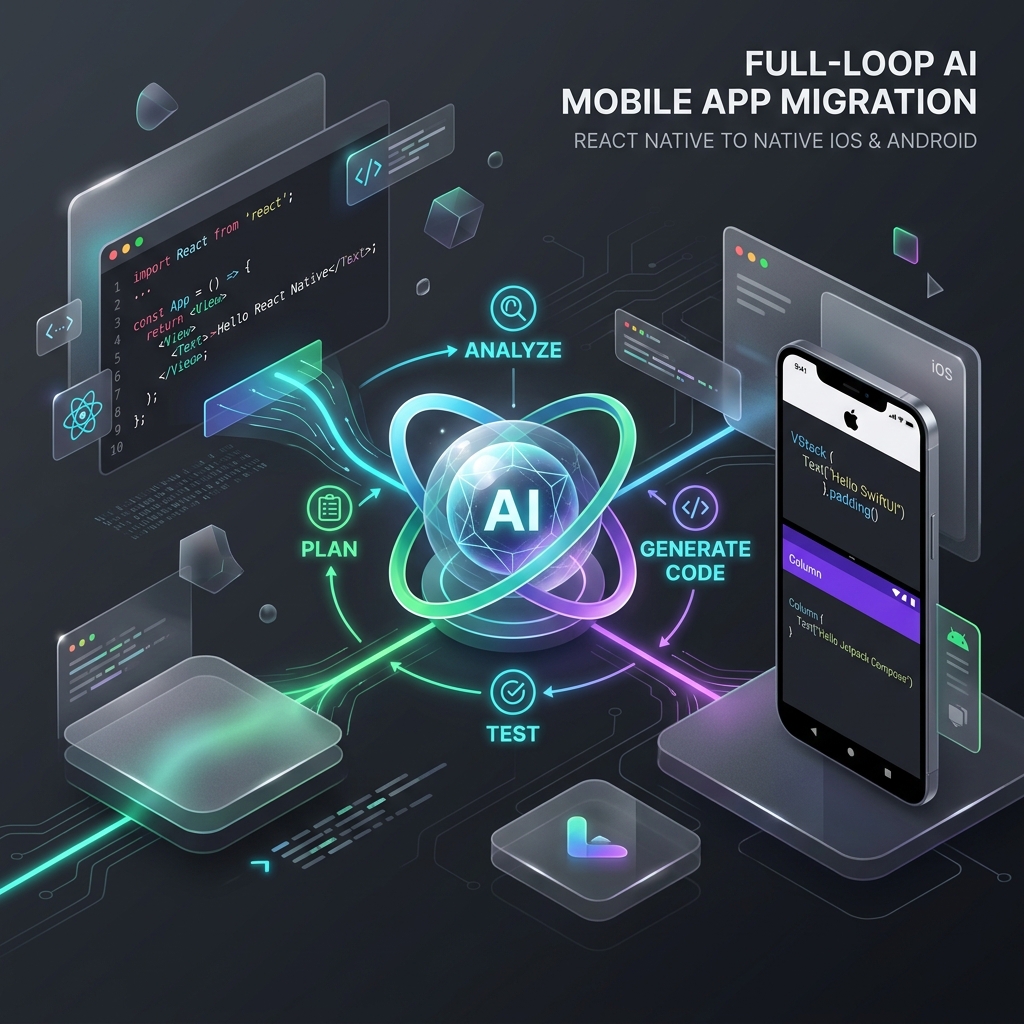
Shopify recently shared how it migrated its Shop app from React Native to fully native iOS and Android implementations using SwiftUI and Jetpack Compose.
What caught my attention wasn't just the technology choice. It was how AI agents changed the economics of the migration.
Traditionally, maintaining separate native codebases meant significantly more development effort. Shopify used AI agents to handle large parts of the migration — analyzing existing behavior, generating implementation plans, writing code, running tests, comparing results, and iterating on issues.
The result was impressive: the rebuilt app achieved faster startup times, smaller Android builds, smoother performance, and high stability.
But the important lesson isn't “AI can write mobile apps.”
It's that AI is becoming capable of working through entire engineering loops, not just generating individual functions.
The developer's role shifts from writing every line to defining the problem, setting constraints, reviewing architecture, validating behavior, and guiding agents toward the desired outcome.
For me, this is one of the more interesting directions in software engineering:
The future may not be about choosing between humans and AI, but about designing engineering workflows where both are significantly more effective together.